Biosphere

Upload following request – I don’t have the setlist any longer though, sorry!

Biosphere is the main recording name of Geir Jenssen (born 30 May 1962), a Norwegian musician who has released a notable catalogue of ambient electronic music. He is well known for his works on ambient techno and arctic themed pieces, his use of music loops, and peculiar samples from sci-fi sources. His 1997 album Substrata was voted by the users of the Hyperreal website in 2001 as the best all-time classic ambient album.

Jenssen was born on May 30, 1962, in Tromsø, a city within the Arctic Circle in the northernmost portion of Norway. He was inspired by the music of artists such as New Order, Depeche Mode, Wire, and Brian Eno, which he described as “like discovering a new universe—a universe which I wanted to be a part of”. In 1983, he bought his first synthesizer and composed his first piece of music, taking influence from his archaeological studies, later stating “Studying the Ice Age and Stone Age has definitely influenced my music.” In 1984 Jenssen issued his first album, Likvider, released on cassette only and credited to E-man.

In 1985, Jenssen was part of the newly created Norwegian moody synth trio Bel Canto with Nils Johansen and singer Anneli Drecker. The band signed with Belgian label Crammed Discs and to Nettwerk in North America, and relocated to Brussels. Jenssen, however, soon returned to Tromsø, collaborating with the other band members by post, and continuing with his solo work. Bel Canto released two albums while Jenssen was a member, White-Out Conditions and Birds of Passage. In 1990, he left the band in order to pursue a different music style altogether, and began using a sampler.

Throughout the late 1980s, Jenssen used the moniker Bleep, under which he produced various 12″ records, now releasing records via the Crammed Discs subsidiary SSR. His early influences were from acid house and New Beat music. Released in 1990, The North Pole by Submarine was the only album recorded as Bleep. Further singles followed in 1990 and 1991 before Jenssen abandoned the Bleep moniker and again changed musical direction.

biosphere-musician-a8b71a25-cebb-4d1a-ae56-029e723d9a3-resize-750

Following the release of The North Pole by Submarine, Jenssen began releasing his music as Biosphere on obscure Norwegian compilation albums. His first Biosphere releases were the 12-inch single “The Fairy Tale” and the album Microgravity, both of which were rejected by SSR as unmarketable. Microgravity was released in 1991 on the Norwegian label Origo Sound, and saw wider release via the R&S Records subsidiary Apollo in 1992, to much critical acclaim. In 1992, Jenssen contributed “I’ll Strangle You” to Hector Zazou’s Sahara Blue project.

In 1994, the second Biosphere album, Patashnik (allegedly Russian – however this is a typo, the correct word is popuchik(попутчик) for “traveller” or “goner”), was released. Through Patashnik, Jenssen continued to explore his ambient-house stylings to an even greater extent. Patashnik contained the first hints of the reduction in beat-driven song structure that would mark later Biosphere releases. Unlike the first album, Patashnik was quickly picked up by a comparatively large international audience, which brought Biosphere greater recognition. Jenssen also recorded as Cosmic Explorer, scoring a hit in Belgium with the EP The Hubble.

In 1995, Levi Strauss & Co. was searching for a new angle to add to their television advertisement campaign (which up to that point had never featured electronic music), and they decided to use the uptempo track “Novelty Waves” from Patashnik. Shortly thereafter, “Novelty Waves” was released as a single (featuring remixes by various other artists), and managed to chart in several countries, reaching #51 in the United Kingdom. Although Jenssen never regretted his approval for use of the track, he also never sought this kind of fame and subsequently turned down various requests by his record company and peers to collaborate with well-known techno and drum ‘n bass artists or to create a follow-up album in the same style. During that same year, Biosphere contributed the song “The Seal and the Hydrophone” exclusively to Apollo 2 – The Divine Compilation released by Apollo Records.

Released in 1997, Substrata is a purely atmospheric ambient Biosphere album, released on Brian Eno’s All Saints Records. Substrata, which marked Jenssen’s embarkation towards an intensely minimal style, is not only often considered to be Jenssen’s best work to date, but is also seen as one of the all-time classic ambient albums. Substrata contains notable samples from the American TV show Twin Peaks.

In 2000, Jenssen released Cirque on his new home Touch, an ambient album driven by muffled beats, samples, and minimal atmospherics. Though Cirque briefly revisited territory covered by earlier Biosphere releases, the rhythm section throughout the album remains an element of the background, unlike Jenssen’s first two Biosphere releases, wherein the drums occupied a dominating proportion of the foreground.

In 2002, he released Shenzhou, the fifth full-length album under the name Biosphere. This album was a more abstract work, comparable to Aphex Twin’s 1994 album Selected Ambient Works Volume II. The material on the album draws from elongated, pitch-shifted loops taken from Debussy’s La Mer (The Sea), and Jeux.

Released in 2004, Autour de la Lune stands as the most minimal and austere Biosphere album to date. The drones employed on this album are comparable to Coil’s 1998 album Time Machines in their timbre and slow rate of change. The bulk of this work was originally commissioned and broadcast in September 2003 by Radio France Culture for a musical evocation of Jules Verne.

In 2006, Jenssen released Dropsonde, a half beatless, half rhythmic album composed of jazz rhythms evocative of Miles Davis’ 1970s jazz fusion works. A partial vinyl sampler was released a few months earlier in 2005.

In 2009, Biosphere issued Wireless: Live at the Arnolfini, Bristol, his first live album, containing new tracks such as “Pneuma” and “Pneuma II”.

Jenssen has scored a number of films, including Eternal Stars (1993) and Insomnia (1997). He collaborated with German ambient composer Pete Namlook on Fires of Ork, and has also worked with Jah Wobble’s Invaders of the Heart and with Bobby Bird of Higher Intelligence Agency. In 2010, two soundtracks were announced on Biosphere’s website, for German film “Im Schatten” and Norwegian “NOKAS”.

On 27 June 2011, Geir Jenssen released the album N-Plants, inspired by the Japanese post-war economic miracle. The album theme is related to nuclear plants in Japan.

John Peel

p01bqgyr

John Robert Parker Ravenscroft, OBE (30 August 1939 – 25 October 2004), known professionally as John Peel, was an English disc jockey, radio presenter, record producer and journalist. He was the longest serving of the original BBC Radio 1 DJs, broadcasting regularly from 1967 until his death in 2004.

John Peel was like the father I never had. His radio shows at 10pm from Monday to Friday on Radio 1 didn’t just keep you awake – they educated you.

Only Peel could play records the wrong side or at the wrong speed and then brilliantly dig himself out of a hole like he did – spectacularly.

And how many teenagers (and perhaps folk way more advanced in years than that) invented their own festive fifties?

Legend and national treasure, John would have turned eighty today had it not been for his untimely passing in 2004.

Keepingitpeel on Twitter are having quite a day of Peel celebration and memories and I wanted to include bits of that in this tribute with this Guardian review of his autobiography.

Unfinished sympathy

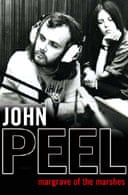
John Peel’s wife Sheila Ravenscroft completed Margrave of the Marshes after he died – and has produced an immensely compelling portrait, says Simon Garfield

Margrave of the Marshes
by John Peel and Sheila Ravenscroft
Bantam Press £18.99

Margrave of the Marshes by John Peel

Almost a year ago, John Peel’s memorial service seized up a town. The bewildered police in Bury St Edmunds had expected hundreds of people, not thousands, and the cathedral was full more than an hour before his family arrived with the coffin. Those of us left outside in the drizzle who believed they had left home in plenty of time were forced to reflect that perhaps John had not been talking to us alone after all.

As the funeral progressed, the Radio 1 website filled with the sort of emotion not usually evident when an important British broadcaster passes away. People who had never met him wrote of how much he meant to them, and how he got them through a difficult period in their lives. Many messages had an intensity that would have driven Peel to helpless tears. It was difficult to explain precisely what had caused this outpouring – something that continues this month with many anniversary tributes. But it was clear that it wasn’t just about playing challenging records late at night or revealing complicated domestic situations on Saturday mornings. It may just be that he achieved effortlessly from the start what most presenters never achieve in their entire careers: a personal relationship with the listener that made us believe we were hearing from a friend.

His autobiography was well under way by the time he died of a heart attack in Peru at the age of 65, but his life and his account of it was so full of diversions that he had not yet reached the point where he had spun a record on air. In fact, he had only just lost his virginity. Peel would thus have referred to this book as a game of two halves: his own story of his school days and national service followed by his wife Sheila’s report of his subsequent career and family life. Each section has its own pleasures and limitations, but jointly they may have created a publishing first: the patient and analyst in one immensely compelling volume.

Longstanding readers of this newspaper’s review pages will remember Peel as an original and humorous writer, but may be surprised at how well he had grasped this longer form. The narrative is chronological, but it is informed by more recent asides; his teenage traumas, for example, are followed by tales of the middle-aged female fan who was convinced the famous Peel lived in a commune in Baker Street with Lou Reed and Stevie Wonder (Peel played along with this, informing her how he dreaded the weeks when it was Stevie’s turn to cook). In other words, we do get glimpses of his wonderful future career to redeem the tales of masturbation, bullying and all-round teenage desolation.

There was not much warmth in his Cheshire childhood home, certainly not from his parents. Peel was born a few days before the outbreak of the Second World War, and he didn’t see his father until it was over. He remained a distant figure on his return, and his son recalls his fondness for regular bowel movements and his dislike of hugging. His mother is described vividly in terms of her fondness for the solitary consumption of romantic fiction and wearing embarrassing outfits whenever in the presence of his schoolfriends. His parents divorced when John was in his teens, and much later his mother hooked up with the actor Sebastian Shaw, who played Darth Vader in Return of the Jedi.

His mother regularly administered domestic beatings when John was perceived to have erred, something that stood him in good stead when he became a boarder at Shrewsbury. Peel, still known then as John Ravenscroft, was not the academic type, and his school reports display nothing but despair. Yet he was a handsome youth and his study monitors found him irresistible. His account of servicing these boys and being buggered by one of them in a cemetery toilet has already made headlines, although he writes about it with more of a shrug than a howl, as if he was reading a favourite dismal lyric by the Smiths. Indeed, with a couple of exceptions, most of his writing has a soft, forgiving tone: he even finds an agreeable side to Tony Blackburn and Chris Moyles; the worst he can say about pop stars is that Sting is ‘tiresome’.

After boarding school, national service held few horrors. Peel’s half of the book ends in the United States, but it is clear his heart isn’t in his insurance job. His time is split fairly evenly between meeting John Kennedy and Nixon on the campaign trail, seeing a stripper called Chris Colt, The Girl with the 45s, and pursuing his burgeoning taste for obscure rock’n’roll and blues.

His flash-forwards contain anecdotes he has told so many times that he is almost apologetic about recounting them again, although they all bear publication. We get the first time he heard Elvis, on Two-Way Family Favourites, the fanaticism for Liverpool FC that led to the middle-naming of his children Anfield, Anfield, Shankly and Dalglish, and the Bay City Rollers gig at which Tony Blackburn was escorted across a lake by a Womble (‘Look on this and marvel,’ Peel murmured to Johnnie Walker at the time).

It is left to his wife and children to take the story on, and explain the reason for the crowds at the funeral. It is the closest thing to a 200-page love letter that we may read this year, but its subject would have been appalled if his faultlines weren’t also on display. His huge influence on the musical tastes of two generations is handled well, but it’s the disclosure of his great sensitivity and private doubts that provides the most rewarding insight. Domestic life in Suffolk was chronicled by Peel on Home Truths on Radio 4 (often in a little too much detail for his children), but there were only hints that he considered himself an inadequate father. Sheila writes of his distress at being absent so much when his children were young, to the point that he confused their names; he regarded even 10 minutes’ quality time with them each day as an impossible goal. And then there were his unpredictable and occasionally raging moods that would send his children scurrying for shelter.

The second half draws heavily on Peel’s diary entries and published writing, and there are some wonderful and woeful surprises, not least his soft spot for Status Quo and the details of his disastrous first marriage to an underage girl in America. It was intriguing to discover how often Sheila’s own reminiscences are framed with a similar phraseology to her husband’s (she writes of the ‘dimly lit corners of the internet’ where there are sites dedicated to his on-air gaffes). The title of the book is the title Peel jokingly conferred on himself in his grander moments at home; a possible alternative was If He Ever Hits Puberty, an expression his Radio 1 producer John Walters used to employ with regularity (‘If John ever hits puberty, we’ll both be in trouble … ‘).

The book ends, bravely I think, with lists of events Peel sent to his literary agent for possible inclusion in an autobiography before a deal was signed: ‘Terror at attending Desert Island Discs anniversary do in ill-fitting suit … an exhibition of awful Japanese paintings with Samantha Fox and Shirley Williams for Gloria Hunniford on TV … anecdotes (unflattering) about visits to Peel Acres by Sue Cook (who broke our electric blanket) and Bob Geldof.’ All of which would have made this a longer, increasingly eccentric but probably no more delightful book.


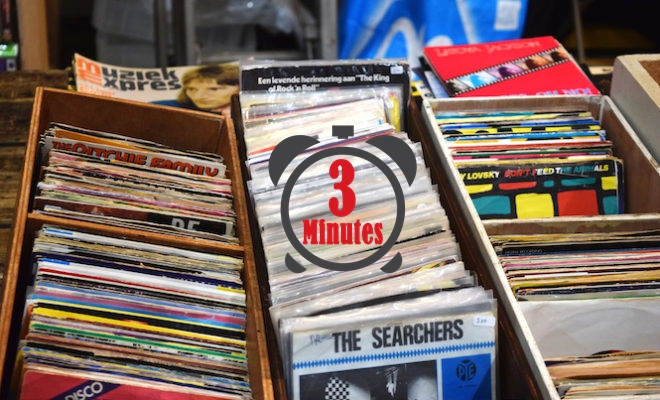
Three Minute Heroes: Great songs of 3 minutes (or slightly less)

© The Vinyl Factory, Mega Record Fair Utrecht 2015, Photography Anton Spice

It used to be said that the perfect pop song lasted just under three minutes. Now all that matters is the first 30 seconds. Songwriters desperate to catch the ear of fickle modern listeners are loading introductions with catchy hooks, samples and recognisable vocals. Experts say the shift is driven by streaming services such as Spotify, which are said to pay royalties only if a track is played for more than half a minute.

Most 45 rpm singles in the 1950s and early 1960s were around 3 minutes in length, the majority less than 180 seconds. This was both a historical hangover, but it was also down to the fact that AM radio liked their records to be short as well as a technological necessity in that this allowed the records to be as loud as possible; putting more grooves on a 45 to pack in more music meant that they played quieter.

The issue for me. reading Spotify and similar online lists, was that they were filled with anything and everything under three minutes duration. For me, the pre-requisite would have to be ten seconds either side, to give a more accurate evaluation of a three-minute recording.

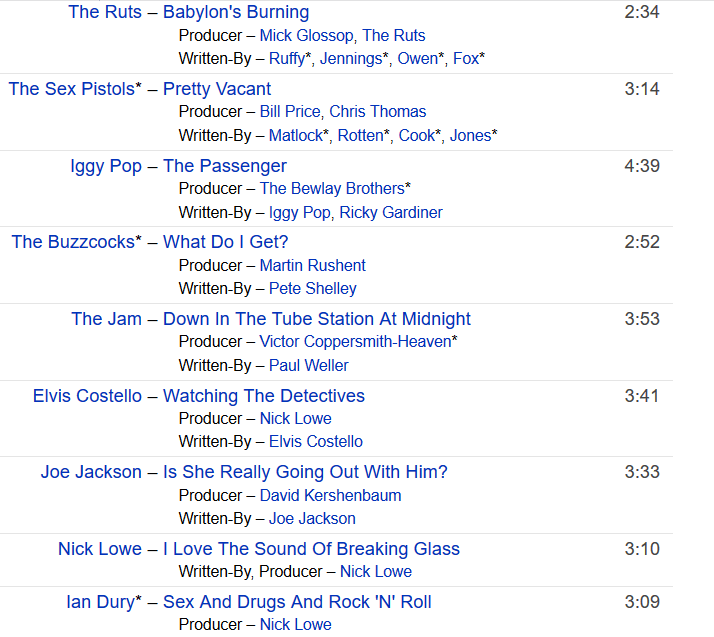
Look at this compilation. Released in 1992 it proved very popular but you’d be hard-pressed to find anything much that stuck to the three minute hashtag.

R-384351-1443791861-8131.jpeg

9

Even Magazine’s “Shot By Both Sides”, the song that spawned my username is closer to four minutes!

So, songs exactamundo three minutes or slightly less. To that end, I’ve narrowed down my ten personal favourites, each with the story behind the song.

10: Public Image Limited – “Public Image” (02:59)

Something that’s only come to my cognisance in doing this article is that Public Image starts with ‘hello’ and ends with ‘goodbye’ – however as well as being such a great tune, it’s the reference to Monopoly that I like.

The song reached number nine on the UK Singles Chart. Public Image was written when Lydon was in the Sex Pistols. The song addresses John Lydon’s feelings of being exploited in the Sex Pistols by Malcolm McLaren and the press. Along with being released as a single, it appeared on PiL’s 1978 debut album Public Image: First Issue.

On the song, PiL leader John Lydon has said:

‘Public Image’, despite what most of the press seemed to misinterpret it to be, is not about the fans at all, it’s a slagging of the group I used to be in. It’s what I went through from my own group. They never bothered to listen to what I was fucking singing, they don’t even know the words to my songs. They never bothered to listen, it was like, ‘Here’s a tune, write some words to it.’ So I did. They never questioned it. I found that offensive, it meant I was literally wasting my time, ’cause if you ain’t working with people that are on the same level then you ain’t doing anything. The rest of the band and Malcolm never bothered to find out if I could sing, they just took me as an image. It was as basic as that, they really were as dull as that. After a year of it they were going ‘Why don’t you have your hair this colour this year?’ And I was going ‘Oh God, a brick wall, I’m fighting a brick wall!’ They don’t understand even now.

Hello, hello
Hello, hello
Hello, hello
You never listened to a word that I said
You only seen me from the clothes that I wear
Or did the interest go so much deeper
It must have been to the color of my hair
(The) Public image
Oh what you wanted was never made clear
Behind the image was ignorance and fear
You hide behind this public machine
You still follow same old scheme
(The) Public image
Two sides to every story
Somebody had to stop me
I’m not the same as when I began
I will not be treated as property
(The) Public image
Two sides to every story
Somebody had to stop me
I’m not the same as when I began
It’s not a game of monopoly
(The) Public image
Public image you got what you wanted
The public image belongs to me
It’s my entrance my own creation
My grand finale, my goodbye
Public image
Public image

Goodbye


09: The Smiths – Shoplifters Of The World Unite (02:59)

Very few songs in The Smiths catalogue go that close to the three-minute mark but while choice is limited, I reckon this little gem will go down a treat with fans of Manchester’s own fab four.

Released in January 1987, it reached No. 12 in the UK Singles Chart. As with most of the Smiths’ singles, it was not included on a studio album. It is featured on the compilation albums The World Won’t Listen, Louder Than Bombs, Singles and The Sound of The Smiths.

The title alludes to the slogan “Workers of the world, unite!“, and the 1966 David and Jonathan hit “Lovers of the World Unite”.

During a 1987 interview with Shaun Duggan, Morrissey said of the song: “It does not literally mean picking up a loaf of bread or a watch and sticking it in your coat pocket. It’s more or less spiritual shoplifting, cultural shoplifting, taking things and using them to your own advantage”.

Learn to love me
Assemble the ways
Now, today, tomorrow and always
My only weakness is a list of crime
My only weakness is well, never mind, never mind

Oh, shoplifters of the world
Unite and take over
Shoplifters of the world
Hand it over
Hand it over
Hand it over

Learn to love me
And assemble the ways
Now, today, tomorrow, and always
My only weakness is a listed crime
But last night the plans of a future war
Was all I saw on Channel Four

Shoplifters of the world
Unite and take over
Shoplifters of the world
Hand it over
Hand it over
Hand it over

A heartless hand on my shoulder
A push and it’s over
Alabaster crashes down
(Six months is a long time)
Tried living in the real world
Instead of a shell
But before I began
I was bored before I even began

Shoplifters of the world
Unite and take over
Shoplifters of the world
Unite and take over
Shoplifters of the world
Unite and take over
Shoplifters of the world
Take over

08: Blondie – “Picture This” (02:57)

“Picture This” was written by Chris Stein, Debbie Harry and Jimmy Destri. Debbie Harry wrote the lyrics while Destri and Stein each wrote portions of the music. The B-side of the single, “Fade Away And Radiate”, featured Robert Fripp on guitar and was also included on the Parallel Lines album. “Picture This” was included on the international version of the band’s first ‘greatest hits’ compilation The Best of Blondie, released in October 1981.

It was originally released in the UK in 1978 as the lead single from their third album Parallel Lines. It reached number 12 in the UK, giving Blondie their third UK Top 20 hit. It also charted in various other countries but was not issued as a single in the US.

All I want is a room with a view
a sight worth seeing
a vision of you
All I want is a room with a view

I will give you my finest hour
the one I spent
watching you shower
I will give you my finest hour

All I want is a photo in my wallet
a small rememberance
of something more solid
all I want is a picture of you

Picture this – a day in December
Picture this – feezing cold weather
You got clouds on your lids and you’d be on the skids if it
weren’t for your job at the garage
if you could only,
Picture this – a sky full of thunder
Picture this – my telephone number
One and One is what I’m telling you

All I want is 20-20 vision
a total portrait
with no omissions
All I want is a vision of you

If you can…

Picture this – a day in December
Picture this – feezing cold weather
You got clouds on your lids and you’d be on the skids if it
weren’t for your job at the garage
if you could only,
Picture this – a sky full of thunder
Picture this – my telephone number
One and One is what I’m telling you

get a pocket computer
try to do what ya used to do


07: The (English) Beat – “Best Friend” (03:04)

A recent thread on Twitter asked for folk to mention their favourite ‘happy’ songs. Along with The Happening by Diana Ross and The Supremes, this number from Dave Wakelin’s boys is so upbeat, it deserves a place here even though it’s slightly over three minutes.

If I Just Can’t Stop It was the living embodiment of Pete Townshend’s maxim that “Rock ‘n’ Roll won’t eliminate your problems, but it will sort of let you dance all over them,” then “Best Friend” just might be the epitome of that embodiment.

With Andy Cox’s 12-string Rickenbacker playing high-and-seek with Dave Wakeling’s six-string and Saxa providing commentary throughout, “Best Friend” soars like the greatest power pop songs of the era.

Naturally, the soaring music is contrasted with Dave Wakeling’s scathing lyrics:

I just found out the name of your best friend,
you been talkin’ about yourself again,
and no one seems to share your views.
why doesn’t everybody listen to you kid?
how come you never really seem to get through, is it you?
talk about yourself again, you.
talk about yourself,
always you, you, you.
talk about yourself again.

she’s on a holiday,
she’s got her summer frock on.
suck on an ice cream,
it’s meltin’ in the hot sun.
first date’s made you pray for more.
i wanted you, wanted.
everybody knows the score,
i wanted you, wanted.
what are we pretendin’ for?
let’s talk about ourselves on the floor.
let’s talk about yourselves, nothing more I promise.
talk about ourselves again.


06: The Jam – “Smithers-Jones” (03:00)

That final verse, in fact the whole final sixty seconds of this song that’s high in my all time top ten songs by The Jam is just sublime!

Back in the sixties and seventies, when you left school those who weren’t massively educated either followed in the family business or took a job with a big industry company; gas, water, transport etc and were generally guaranteed a job for life. That almost certainly does not happen anymore and now looking less likely than ever as the big corporates talk about employing robots to do your everyday jobs. The city gent image of that long-forgotten era, with the men in their pin-stripe suits, bowler hats and umbrellas inspired a song which ended up as a B side, but its sentiment is probably more poignant now than it was back then.

The song is Smithers-Jones, a track recorded by The Jam which ended up on the B-side of their 1979, number 17 hit, When You’re Young. Like the Beatles whose almost entire hit singles catalogue were written by Lennon & McCartney, except From Something which was written by George Harrison, 16 of the the Jam’s 18 hits were written by lead singer and guitarist Paul Weller. David Watts, written by Ray Davies, and News of the World written by the band’s bass player, Bruce Foxton, were the only exceptions.

Bruce also wrote Smithers-Jones and said of it in an interview with Pennyblack Music, “Yeah, Smithers Jones was, and is, especially heartfelt. You still do get loads of people who give their lives to the job and then once they are past their sell-by date loyalty doesn’t matter. That is what happened to my Dad and hence that is how Smithers Jones came about. There is a lot of anger there in that song.”

It’s a shame there weren’t more Foxton-penned songs, he’d written two tracks that appeared on the 1977 album This Is The Modern World and one track on The Gift from 1982, Vic Coppersmith-Heaven, the Jam’s producer gave this explanation in an interview with Richard Buskin, “There were some Bruce songs that [manager and Paul’s father] John Weller was trying to convince me to include, but it was less about whose song than it was about the concept of the album. We were all very involved with the production at that stage, and we worked together pretty much as a four-piece in terms of choosing the songs. Smithers-Jones worked because it was fresh, it was new and it was interesting to have a different kind of arrangement.” The version that appeared as the flip side to When You’re Young was a band arrangement and, in my opinion the better version, but for the 1979 album Setting Sons it was a re-worked as a much more orchestral version. Vic continued, “We transposed rhythms from the original band arrangement to the violin score. It was a very good song. Paul’s music virtually conceptualised the Jam at that point.”

Here we go again, it’s Monday at last,
He’s heading for the Waterloo line,
To catch the 8 a.m. fast, its usually dead on time,
Hope it isn’t late, got to be there by nine.

Pin stripe suit, clean shirt and tie,
Stops off at the corner shop, to buy The Times
‘Good Morning Smithers-Jones’
‘How’s the wife and home?’
‘Did you get the car you’ve been looking for?’

Let me get inside you, let me take control of you,
We could have some good times,
All this worry will get you down,
I’ll give you a new meaning to life – I don’t think so.

Sitting on the train, you’re nearly there
You’re a part of the production line,
You’re the same as him, you’re like tinned-sardines,
Get out of the pack, before they peel you back.

Arrive at the office, spot on time,
The clock on the wall hasn’t yet struck nine,
‘Good Morning Smithers Jones’
‘The boss wants to see you alone’
‘I hope its the promotion you’ve been looking for’

Let me get inside you, let me take control of you,
We could have some good times,
All this worry will get you down,
I’ll give you a new meaning to life – I don’t think so.

‘Come in Smithers old boy’
‘Take a seat, take the weight off your feet’
‘I’ve some news to tell you’
‘There’s no longer a position for you’ –
‘Sorry Smithers-Jones’.

Put on the kettle and make some tea
It’s all a part of feeling groovy
Put on your slippers turn on the TV
It’s all a part of feeling groovy
It’s time to relax, now you’ve worked your arse off
‘cos the only one smilin’ is the sun-tanned boss
Work and work and work and work till you die
‘cos there’s plenty more fish in the sea to fry


05: REM – “Fall On Me” (02:59)

Though R.E.M. singer Michael Stipe once described the song as “pretty much a song about oppression,” the subject of the song was initially about acid rain and its effects on the environment, hence the first line of the chorus, “Don’t fall on me.”

When it first appeared during live concerts in 1985, the song had a different melody which had been entirely rewritten by the time of its recording for Lifes Rich Pageant. The counter-melody in the second verse is actually the song’s original tune and features the original acid rain inspired lyrics.

In an interview with David Fricke, singer Michael Stipe commented that the finished version of the song “is not about acid rain. It’s a general oppression song about the fact that there are a lot of causes out there that need a song that says, ‘Don’t smash us.’ And specifically, there are references to the Leaning Tower of Pisa and the guy dropping weights and feathers.”

In audience patter prior to a performance of the song on VH1 Storytellers in 1998, Stipe again mentioned the apocryphal tale of Galileo Galilei dropping feathers and lead weights off the Leaning Tower of Pisa (to test the laws of gravity) as partial inspiration for the first verse:

“I was reading an article in Boston when I was on tour with the Golden Palominos, and Chris Stamey showed me this article about this guy that did an experiment from the Leaning Tower of Pisa, whereby he dropped a pound of feathers and a pound of iron to prove that there was… a difference in the… density? What did he prove? I don’t even know. [A man shouts out from the audience] What? [“They fall just as fast,” repeated the disembodied voice] They fall just as fast. Thank you very much.”

The song is something of a duet between Stipe and Mike Mills, with the two of them sharing vocals prominently during the bridge and chorus. Mills takes lead vocals for the bridge. Later in the song, the pair are joined by Bill Berry’s vocals in the chorus with the words “it’s gonna fall”.

Stipe filmed and directed the video for this song, in which the lyrics are seen superimposed over upside-down, black-and-white footage of a quarry. Towards the end of the second verse, he misspelled the word ‘Foresight’.

There’s a problem, feathers, iron
Bargain buildings, weights and pulleys
Feathers hit the ground before the weight can leave the air
Buy the sky and sell the sky and tell the sky and tell the sky

Don’t fall on me (what is it up in the air for?) (it’s gonna fall)
Fall on me (if it’s there for long) (it’s gonna fall)
Fall on me (it’s over, it’s over me) (it’s gonna fall)

There’s the progress we have found (when the rain)
A way to talk around the problem (when the children reign)
Building towered foresight (keep your conscience in the dark)
Isn’t anything at all (melt the statues in the park)
Buy the sky and sell the sky and bleed the sky and tell the sky

Don’t fall on me (what is it up in the air for?) (it’s gonna fall)
Fall on me (if it’s there for long) (it’s gonna fall)
Fall on me (it’s over, it’s over me) (it’s gonna fall)

Don’t fall on me

Well, I could keep it above
But then it wouldn’t be sky anymore
So if I send it to you, you’ve got to promise to keep it whole

Buy the sky and sell the sky and lift your arms up to the sky
And ask the sky and ask the sky

Don’t fall on me (what is it up in the air for?) (it’s gonna fall)
Fall on me (if it’s there for long) (it’s gonna fall)
Fall on me (it’s over, it’s over me) (it’s gonna fall)

Don’t fall on me (what is it up in the air for?) (it’s gonna fall)
Fall on me (if it’s there for long) (it’s gonna fall)
Fall on me (it’s over, it’s over me) (it’s gonna fall)

Fall on me, don’t fall on me (what is it up in the air for?) (it’s gonna fall)
Fall on me (if it’s there for long) (it’s gonna fall)
Fall on me (it’s over, it’s over me) (it’s gonna fall)

Fall on me, don’t fall on me

04: Roxy Music – “Virginia Plain” (02:59)

It was the song that gave Roxy Music their big breakthrough, and the summer of 1972 one of its defining chart moments. Yet it was a hit single that didn’t so much ignore the rules as simply get them arse-backwards: no chorus, a faded-in intro and a sudden ending – the opposite of ‘normal’ singles. The song’s title wasn’t even mentioned until the final, dead-stop moment, when singer Bryan Ferry suddenly blurts: ‘What’s her name? Virginia Plain!’

“This day and age when you think of singles, they have the formula perfected,” says Roxy Music guitarist Phil Manzanera. “Straight into the chorus for the beginning, play the hook, quick verse, back to chorus, repeat until fade. There was none of that with Virginia Plain.”

A guileful subversion of existing tastes? An arrogant art-rock mission statement, signalling the arrival of a new way of being?

“No, none of that,” Manzanera insists. “We just hadn’t a clue how to make a single. We’d never done one before.”

In typically back-to-front fashion, Roxy had released their debut album two months earlier, in June 1972. Ripe with songs that had no chorus or didn’t even reference their titles, and often stopped without warning, it nonetheless managed to clip the edge of the Top 10.

Recording and releasing their very first single in August 1972 was almost an afterthought. “We were told: ‘The album’s done reasonably well. You should do a single,’” says Manzanera. “We all sort of went, ‘Oh, all right…’”

When the band entered London’s Command Studios in July, they hadn’t even rehearsed the song. “We just turned up at the studio, Bryan played us these three incredibly simple chords on the piano, and we just started messing around with it there and then,” says Manzanera.

‘We’ was the classic early Roxy line-up, also featuring sax and oboe player Andy Mackay, drummer Paul Thompson and the cryptically-named Eno (no one yet knew his first name was Brian) on VCS3 synthesizer and ‘treatments’, whatever they were. The messing around proved to be extensive. As well as the stream-of-consciousness _joie de vivre of the lyrics (‘Flavours of the mountain streamline, midnight-blue casino floors/Dance the cha-cha thru till sunrise, opens up exclusive doors, oh wow!’_), there were unique sounds: Ferry’s vibrato-heavy voice; the sound of a motorbike roaring off into the distance; Eno’s Tonka-toy synths; most absurd and beautiful of all, a parping oboe.

“Was there ever a hit single with an oboe in it?” muses Manzanera. “I don’t know. But I think the feeling was there should be. No other band at the time seemed to have one.”

But then Virginia Plain had a lot of things going for it that other bands could barely dream of – not least the sense that someone, somewhere, was having a giant laugh at the rest of the world’s expense.

“There were certainly some odd things in it that you couldn’t hope for other people to get,” allows Manzanera. “For instance, the opening verse…” To wit: ‘Make me a deal, and make it straight, all signed and sealed, I’ll take it/To Robert E. Lee I’ll show it, I hope and pray he don’t blow it ’cos/We’ve been around a long time/Tryin’, just tryin’, just tryin’, to make the big time!’ Most people, understandably, assumed Ferry was referring to the Confederate general in the American Civil War. Not so, says Manzanera. The verse had virtually no symbolism at all.

“Robert E. Lee was – and still is, actually – the name of the band’s lawyer. So when Bryan sang of taking a deal to Robert E. Lee and hoping he doesn’t blow it etc, he was being very literal. As that’s exactly what happened when we were offered the deal by Island Records to sign for them.”

Even then, Roxy Music had a reputation as musical futurists ushering in a new age. But what’s striking about the recording of Virginia Plain is just how old-school it was.

Manzanera: “Apart from Brian’s synths and various tape machines, which he had pretty much assembled randomly from whatever weird toys came his way, everything else was very much done as-live in the studio. For the sound of the motorcycle we actually had to borrow someone’s bike. Then wait till the middle of the night and take it out onto Piccadilly Circus, which is where the studio was, because in those days Piccadilly Circus was fairly deserted at night. Hard to believe now, but true. Then we got someone to start the bike up and rev the engines and finally speed off while we stood there recording it with this big reel-to-reel tape-recorder.”

There’s just one question left hanging: who or what was Virginia Plain? Some far-out, beautiful fox like the ones that used to feature on all Roxy’s album covers?

“Sadly, no,” replies Manzanera. “Bryan had been an art student and done a number of paintings, one of which was a sort of Warhol-type pop-art painting of a cigarette packet, which he’d called Virginia Plain.”

So Virginia Plain was a cigarette?

Manzanera laughs. “Well, it was a cigarette packet.”

How very Roxy Music.

Make me a deal and make it straight
All signed and sealed, I’ll take it
To Robert E. Lee I’ll show it
I hope and pray he don’t blow it ’cause
We’ve been around a long time just try try try tryin’ to
Make the big time…
Take me on a roller coaster
Take me for an airplane ride
Take me for a six days wonder but don’t you
Don’t you throw my pride aside besides
What’s real and make believe
Baby Jane’s in Acapulco We are flyin’ down to Rio
Throw me a line I’m sinking fast
Clutching at straws can’t make it
Havana sound we’re trying hard edge the hipster jiving
Last picture shows down the drive-in
You’re so sheer you’re so chic
Teenage rebel of the week
Flavours of the mountain steamline
Midnight blue casino floors
Dance the cha-cha through till sunrise
Open up exclusive doors oh wow!
Just like flamingos look the same
So me and you, just we two got to search for something new
Far beyond the pale horizon
Some place near the desert strand
Where my Studebaker takes me
That’s where I’ll make my stand but wait
Can’t you see that Holzer mane’
What’s her name? Virginia Plain


03: Elvis Costello & The Attractions – “Oliver’s Army” (03:00)

Oliver’s Army is Elvis Costello’s most successful single. Though its lyrics are quite dated, I think there is still an energy about it that keeps it sounding fresh.

The title of this song is a reference to the leader of the Parliamentary Army in the English Civil War against the Royalist Army of King Charles I, Oliver Cromwell, albeit the song has nothing to do with Cromwell really.

Elvis Costello wrote this song in 1978 as he was flying home to England from Belfast. He was disturbed by the sight of so many very young British soldiers walking around with machine guns. It was a time when unemployment figures were at an all-time high and the only option that many young men had in their quest for work was to join the army. Large numbers of squaddies were recruited straight from school, often from poor families and with poor exam results.

The line: with the boys from the Mersey and the Thames and the Tyne refers to the rivers which run through, Liverpool, London and Newcastle, three of the English cities that were suffering severe economic depression during the seventies: hence they were ideal areas for the army to find new recruits.

The song mentions the end of the British Empire and it describes the life of soldiers in the trouble hot-spots of the world, mentioning Northern Ireland, South Africa, Palestine and Cyprus.

Despite the strong political content of this song, many people:  myself included bought this record just because it had a great pop melody.

 In 2008, Costello told Q Magazine “I don’t think its success was because of the lyrics. I always liked the idea of a bright pop tune that you could be singing along to for ages before you realize what it is you’re actually singing. Of course, the downside of that is some people only hear the tune and never listen to the words. After a while, I got frustrated at that.”

The song lyrics contain the words “white nigger:” a phrase that is almost never censored by radio stations. However, in 2013, BBC Radio 6 Music did play the record with the potentially offensive word removed despite having been played by BBC radio stations for over 30 years uncensored. It was an unpopular move with the public, given the intended anti-racist and anti-war theme of the single.

At the Glastonbury Festival in 2013, Elvis Costello performed the song with its original lyrics.

Oliver’s Army features on the album Armed Forces. It was released as a single in February 1979 and peaked at No.2 in the UK singles chart.

Don’t start me talking
I could talk all night
My mind goes sleepwalking
While I’m putting the world to right

Called careers information
Have you got yourself an occupation?

Oliver’s army is here to stay
Oliver’s army are on their way
And I would rather be anywhere else
But here today

There was a checkpoint Charlie
He didn’t crack a smile
But it’s no laughing party
When you’ve been on the murder mile

Only takes one itchy trigger
One more widow, one less white nigger

Oliver’s army is here to stay
Oliver’s army are on their way
And I would rather be anywhere else
But here today

Hong Kong is up for grabs
London is full of Arabs
We could be in Palestine
Overrun by a Chinese line
With the boys from the Mersey and the Thames and the Tyne

But there’s no danger
It’s a professional career
Though it could be arranged
With just a word in Mr. Churchill’s ear

If you’re out of luck or out of work
We could send you to Johannesburg

Oliver’s army is here to stay
Oliver’s army are on their way
And I would rather be anywhere else
But here today
And I would rather be anywhere else
But here today
And I would rather be anywhere else
But here today, oh oh oh oh oh, oh oh oh oh
Oh oh oh oh oh, oh oh oh


02: The Beach Boys – “God Only Knows” (02:54)

God Only Knows is one of those shimmeringly perfect love songs. It worked especially well in that scene in the Wonder Years, because it summed up, too, the uncertainty of adolescence, that first step from the familiar security of childhood Kevin and Winnie were leaving behind and the great unknown of adulthood: “I knew then that the girl next door was gone,” Kevin recalled. “And my life would never be the same again.”

Composed by Brian Wilson, sung by his brother Carl, its lyrics dreamed up by Tony Asher, it appeared on the band’s 1966 masterpiece, Pet Sounds. It opens in a haze of french horns and harpsichord, it marries baroque and West Coast pop, combines multitracked, layered vocals, and some 16 musicians – a cellist, a flautist, and an accordionist among them. Brian Wilson once described the song as “a vision … It’s like being blind, but in being blind, you can see more. You close your eyes; you’re able to see a place or something that’s happening.” The idea of God Only Knows, he added, “summarised everything I was trying to express in a single song.”

Considering the fact that this is a song about devotion, its opening line has always been unsettling: “I may not always love you,” Wilson sings, a sudden cloud of uncertainty in the music’s clear blue sky. Yet it is of course this very line that makes God Only Knows truly extraordinary. This isn’t just a love song. It isn’t just about the billing and cooing, the early doveish days of courtship; it’s a song that recognises the fact that falling in love is somehow terrifying, that you go into that love blindly, as Wilson put it, but that in that blindness you can see that you are who you are because of someone else.

One of the controversies at the time of the song’s release was the fact that it had the word God in its title; it was so unprecedented that for a time the band was fearful that the record would not be granted airplay, while simultaneously fretting that to younger listeners the overtly religious title might seem, in the words of Wilson’s ex-wife, “too square”.

But “God” has its place in this song – not only does the jump into the unknown required to fall in love echo the leap of faith necessary to believe in God, the rest of the song’s lyrics proceed to dismantle the uncertainty of the first line while simultaneously citing godly creations: the stars above and the world that turns and the life that goes on. It first gives us doubt, then finds us reasons to believe.

I may not always love you
But long as there are stars above you
You never need to doubt it
I’ll make you so sure about it

God only knows what I’d be without you

If you should ever leave me
Though life would still go on believe me
The world could show nothing to me
So what good would living do me

God only knows what I’d be without you

God only knows what I’d be without you

If you should ever leave me
Well life would still go on believe me
The world could show nothing to me
So what good would living do me

God only knows what I’d be without you
God only knows
God only knows what I’d be without you
God only knows
God only knows what I’d be without you
God only knows
God only knows what I’d be without you
God only knows
God only knows what I’d be without you
God only knows
God only knows what I’d be without you
God only knows
God only knows what I’d be without you


01: Pixies – “Debaser” (02:57)

There are few more startling examples of avant-garde cinema than Un Chien Andalou (it translates literally as ‘an Andalusian dog’), the surrealist fancy dreamed up by artist Salvador Dali and director Luis Buñuel un 1929. There’s no discernible plot and no one utters a word. A woman prods at a severed hand, a man drags two grand pianos stuffed with the rotting remains of donkeys, another cycles down a quiet street dressed as a nun, ants emerge from a hole in someone’s palm. It’s infamous for one scene in particular, in which Buñuel’s character is seen gazing at the moon before taking a razor and slicing the left eyeball of his dear wife, who sits implacably on a chair.

In the early 80s, it caught the imagination of a young anthropology student in Massachusetts called Charles Thompson. Later, as Black Francis, his noisy surf-punk four-piece the Pixies worked the idea into Debaser, the opening song from the band’s second album, 1989’s Doolittle. Not that the rest of the Pixies necessarily knew that.

“I’ve no idea what he was singing about,” admits lead guitarist Joey Santiago. “And I didn’t want to know either. It was the same throughout Doolittle. I’d catch a word here and there, but it was almost like I was intruding on his privacy. If I’d asked him what it was all about he’d probably tell me to just shut up and play something.”

Debaser opens with a single, throbbing bass line from Kim Deal, before Santiago’s blazing riff and the throaty yelp of Francis: ‘Got me a movie/I want you to know/Slicing up eyeballs/I want you to know/Girlie so groovy/I want you to know/Don’t know about you/But I am un chien Andalusia.’ It’s enough to make your scalp tingle.

Francis and producer Gil Norton were intent on making the structure of the song as unpredictable and abrasive as the lyrics.

“There are three chunks of music in it,” Francis says. “There’s a chorus, verse and pre-chorus. And when you have three chunks of music like that, you don’t necessarily have to put them in a straight order. It’s not just A-B-C, it can be A-C-B-B, whatever. You move things around and work on the transitions. We wanted the most exciting rock’n’roll arrangement.”

Santiago’s frenzied riffage, at full tilt as the song hurtles to its climax, took some working out, but the result is extraordinary.

“I remember having quite a tough time filling those bars at the end,” he recalls. “That was the only part that stressed me out. But when it was done, Gil said: ‘Wow!’”

got me a movie
i want you to know
slicing up eyeballs
i want you to know
girlie so groovy
i want you to know
don’t know about you
but i am un chien andalusia
wanna grow
up to be
be a debaser, debaser

got me a movie
ha ha ha ho
slicing up eyeballs
ha ha ha ho
girlie so groovie
ha ha ha ho
don’t know about you
but i am un chien andalusia

debaser

The curious case of those ‘Top Of The Pops’ albums

TOTP-181

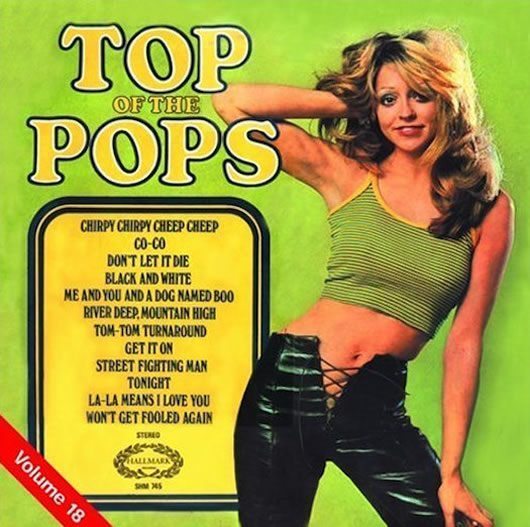
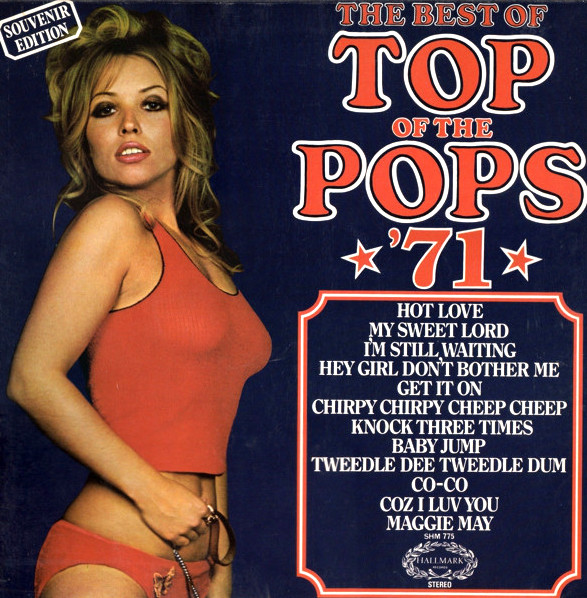
If you’re of an middle-aged persuasion you’ll remember these. In the seventies they were the cheapest ways of owning a copy of songs that were hits but ‘sung’ by someone else. When you were eight, this really didn’t matter and adjectives like “Phwoar” came to mind apropos the album covers that would have tittilated many a pre-pubescent schoolboy. Finbarr Saunders would have had a field day.

CoN8PHFW8AAa6fb

I wanted to reminisce and look back at the making of these LP’s that ingratiated themselves onto our Fidelity record players at the time and fortunately online, some articles were available.

Also. dare you to click on this video… though I certainly recognised January by Pilot! We will never hear anything like this again… and nor would we want to!

Top of the Pops is the name of a series of records issued by Pickwick Records on their Hallmark label, which contain anonymous cover versions of recent and current hit singles. The recordings were intended to replicate the sound of the original hits as closely as possible. The albums were recorded by a studio group comprising session musicians and singers who remained uncredited, although they included Tina Charles and Elton John before they became famous in their own right.

Record producer Alan Crawford conceived the idea for Top of the Pops, having noted several UK labels such as Music for Pleasure pioneer the anonymous covers format during 1967 and 1968. Crawford’s key idea was to create a continuous series of albums with the same title. The Pickwick label agreed to undertake Crawford’s idea and the first volume was issued in mid-1968, containing versions of twelve hits including “Young Girl“, “Jennifer Eccles“, “Do You Know the Way to San Jose” and “I Can’t Let Maggie Go“. A second volume appeared later in the year and included versions of two Beatles songs.

In 1969 new volumes began appearing at generally regular intervals, with a new LP released every six to eight weeks. Volume numbers were not stated on the record sleeves, each edition simply called Top of the Pops, the name derived from the un-trademarked BBC television show of that name, with which there was no direct connection.

totpc

From 1968 to 1985, Hallmark Records released nearly 100 albums consisting of covers of Top 40 hits. According to session singer Tony Rivers, “In those days, more often than not, you had to do 3 songs in 3 hours then you were out of there!! Not much chance of getting good at it!”. However, he also notes that “there was good and there was bad” and that the studio singers and musicians usually tried their best. Dave Thompson for AllMusic stated that “it becomes apparent that the trick is not to look upon the songs as straightforward attempts to copy the hit song, but as interpretations rendered in the style of the hit”.[3] Part sound-alikes, part true covers, the series sold well, and two of the albums reached No. 1 in the UK Albums Chart. In 2002, Hallmark Records went back to the mastertapes, re-issuing several of the original albums, and releasing compilations using the recordings, which have a following of their own.

During the early 1970s, the Top of the Pops series enjoyed considerable success and buoyant sales. Budget albums were accepted into the main UK album charts for a few months in 1971, during which four Top of the Pops LPs charted, and two made No. 1. However, they were disqualified in early 1972 since their budget selling price was perceived as giving them an unfair advantage in the market.

57-6

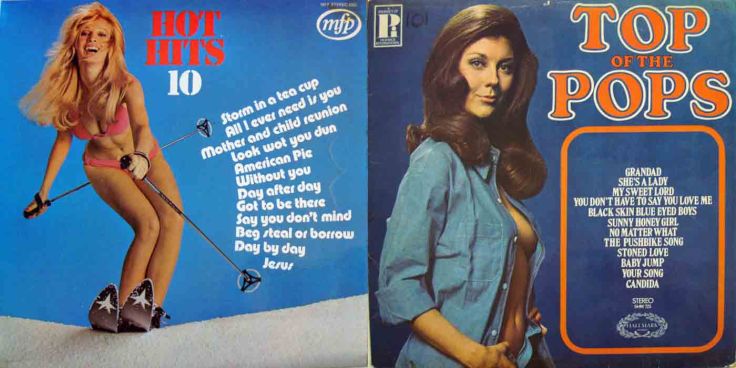
The albums continued to be released at regular intervals throughout the 1970s, with the general theme and cover art largely unchanged throughout. The cover designs featured female models in period attire, some with the models in skimpy clothing such as miniskirts and bikinis.

There were numerous similar album series in existence in the 1970s, put out by other labels. These include 12 Tops on the Stereo Gold Award record label, Hot Hits on the Music for Pleasure label, 16 Chart Hits on the Contour label, and Parade of Pops on the Windmill label (and, later, the Chevron label), plus several others. Some of these were also commercially successful.

While recently searching for Car 67 (Driver 67) to download from Youtube, scrolling down I discovered a version with said TOTP treatment, clicked play and heard just how bad most of this stuff must have been.

We can laugh at it now but at the time I guess many households owned copies of this series of albums which were cheap as chips and even sold in supermarkets.

And here it is…

Anyway, on with the story…

Released every couple of months, ‘Top Of The Pops’ and ‘Hot Hits’ sold almost underneath the radar for some years, until a brief change in the chart eligibility rules allowed the titles into the main album countdown. Thus, early in August 1971, ‘Hot Hits 6’ reached No. 1 and then, two weeks later, ‘Top Of The Pops 18’ did the same, incongruously stealing the top spot from the Moody Blues’ ‘Every Good Boy Deserves Favour.’

The album contained versions, of varying degrees of accuracy, of such recent favourites from the hit parade as Middle Of The Road’s ‘Chirpy Chirpy Cheep Cheep,’ Hurricane Smith’s ‘Don’t Let It Die,’ T. Rex’s ‘Get It On’ and the Rolling Stones’ ‘Street Fighting Man’ — all gamely performed, if unlikely to convince diehard fans.

The 20th volume in the ‘Top Of The Pops’ series also made the chart summit that November, before the chart ruling was revoked, after the major companies complained that the budget releases had an unfair pricing advantage. Nevertheless, the albums continued to sell throughout the 1970s, finally coming to a halt with Volume 91 in 1982.

The main series of Top of the Pops ran to 92 volumes. Albums were released continuously from mid-1968 to mid-1982, with one more following in 1985. These 92 albums account for 1,190 individual recordings; click the link below to find out more.

Top Of The Pops: The Definitive Website

I wanted to find an image of one of these albums that is etched in the memory bank but can’t see it on the link. It had a green cover and I don’t remember the photo and of course it may not have been a TOTP album but one of the MFP series, This album would have been early seventies and had versions of Back Off Boogaloo (Ringo Starr) and Radancer (Marmalade) on it – I do remember that in comparison to the originals, these atually weren’t that bad renditions.

In the late 1970s the main studio band behind the recordings was dispersed, and both the group’s leader Tony Rivers and the regular producer Bruce Baxter left the fold. As a result, from about 1978, Pickwick compiled the LPs from material recorded by external companies. The series ceased in 1982 with volume 91, though a one-off volume (92) was released in 1985.

The end-of-year compilations have been released on CD, as have four of the original 92 sets. Pickwick have also issued a number of themed compilations made up from Top of the Pops recordings, with CDs such as Disco Fever, When They Was Fab, and Knowing Me, Knowing You, an Abba tribute album. In addition, most Top of the Pops albums have been released on iTunes in several countries, credited to the “Top of the Poppers”.

The story of Two Tribes

frankie-goes-to-hollywood-resize-2

“Just think of it. War breaks out and nobody turns up”

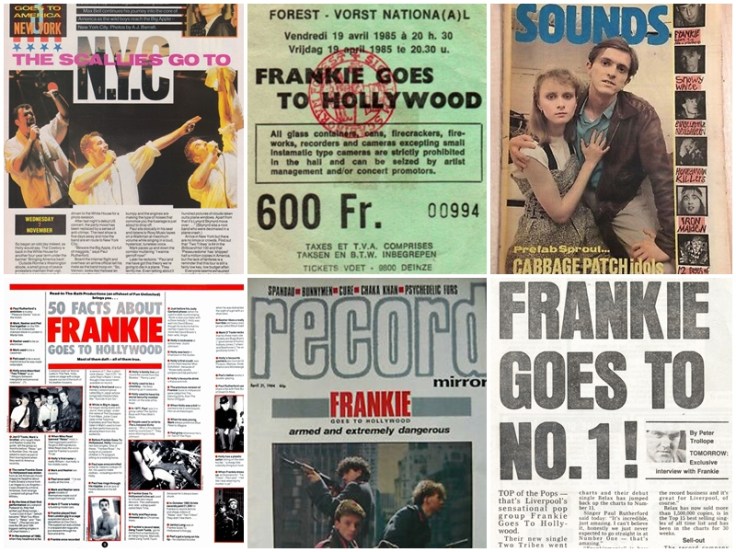
It took the music world a little by surprise and when it was all at its peak, you were imagining that there’d been nothing so euphoric or hysterical since The Beatles. For the best part of 1984, Frankie were everywhere you were or went, on vinyl, on the radio, on posters, on t-shirts and most of all, in your head.

I had a few of the t-shirts (bought from Our Price) and the three 12″ singles, Annihilation, Carnage and Hibakusha.

page

Having already courted controversy with their single ‘Relax,’ Frankie Goes To Hollywood sealed their place in history by writing and redording this eloquent summary of the political landscape at the beginning of the ’80s. The Cold War was back in the headlines; American nuclear missiles sat on English soil in Greenham Common and old emnities between East and West had resurfaced.

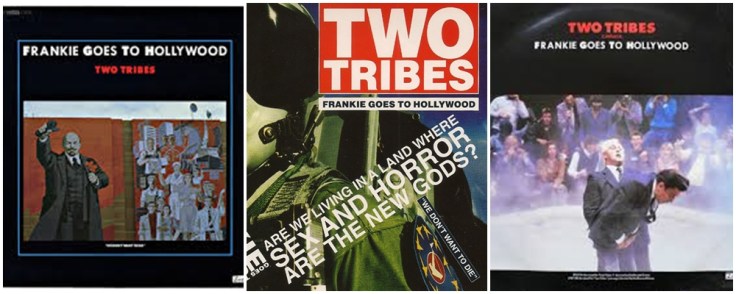
Two Tribes appeared in the form of six mixes, including “Annihilation”, “Carnage”, “Hibakusha”, “Cowboys and Indians”, “We Don’t Want to Die” and “For The Victims Of Ravishment”.

Recorded by ’80s producer, Trevor Horn, the song was very much of its time, which may explain why so few artists have covered it. However in terms of the song’s ability to capture the paranoia and futility of the last days of the Cold War, it remains peerless.

The first 12-inch mix (“Annihilation”) started with an air-raid siren, and included advice from Allen about how to tag and dispose of family members should they die in the fallout shelter (taken from the public information film Casualties). This version appeared on CD editions of the album. “Annihilation” was the basis for the “Hibakusha” mix, which was originally released in a limited edition, and appears on the Japanese-only 1985 album Bang!.
page8

“For The Victims Of Ravishment” appeared on the LP and cassette editions of the album Welcome To The Pleasuredome. It is the shortest version, at 3:27 minutes. This mix derived from the “Carnage” mix, which prominently featured strings as well as vocal samples from Allen and the group’s B-side interview.

With membership of CND (the Campaign for Nuclear Disarmament) at its all-time highest, popular opinion amongst the young was very much against old imperialist thinking. Recognising this, Frankie released ‘Two Tribes’ with its introduction taken directly from the UK Government’s ‘Protect and Survive’ public service broadcast: meant to be shown in the event of imminent nuclear attack. And if that wasn’t provocative enough, the song came accompanied by a video (directed by ex-10CC stars, Godley & Creme) which showed lookalikes of US president Ronald Reagan and USSR president Konstantin Chernenko duking it out in a bare-knuckle arena.

“Today, America apologised for being late for World War 1 and World War 2, but promised to be really punctual for the next one.”

“My fellow Americans, I’m pleased to tell you today that I’ve signed legislation that will outlaw Russia forever. We begin bombing in five minutes.”

These jokes from the satirical show Not The Nine O’clock News and President Ronald Reagan capture the atmosphere of the world in the early eighties. The Cold War was in its fourth decade. Although we didn’t know it at the time, the Soviet Union was in its death throes. It was a great tine to be Kremlinologist as Soviet leaders were dropping like flies. In the space of two years they had had three leaders Brezhnev, Andropov and Chernenko. The last one didn’t last long either.

He would be replaced by Gorbachev after just over a year in the job. At the same time we saw the rise of two Western leaders who did not want to coexist peacefully with the USSR. Ronald Reagan and Margaret Thatcher were Cold Warriors. Conflict seemed inevitable. And remember, we were still living in the age of MAD, the doctrine of mutually assured destruction; you destroy us – we will destroy you. Each side had the capability to destroy the planet many times over. How did we ever get up every morning?

The fear of nuclear annihilation was reflected in popular culture. In 1982 When the Wind Blows, a graphic novel, by British artist Raymond Briggs, shows a nuclear attack on Britain by the Soviet Union. The novel’s protagonists, a retired couple, Jim and Hilda Bloggs, face the aftermath of a nuclear conflict with a WWII mentality. Briggs offers a searing critique of the government’s civil defence plans. In 1993 the film War Games, a young teenager, played by Mathew Broderick, hacks into the Pentagon nuclear defence system thinking he is in a computer game, and almost starts Armageddon.

Red Dawn a 1984 movie had World War III start with a surprise Soviet and Cuban invasion of the United States. Fortunately a heroic band of teenagers including Patrick Swayze and Charlie Sheen were able to fight off the commie invaders. It would have been even easier if Sheen hadn’t drunk all the Molotov Cocktails. Curiously, this masterpiece was remade in 2012. The baddies were going to be the Chinese, but this would have hit receipts at the Chinese box office, so it was the North Koreans who invaded.

smashhits117-301985b

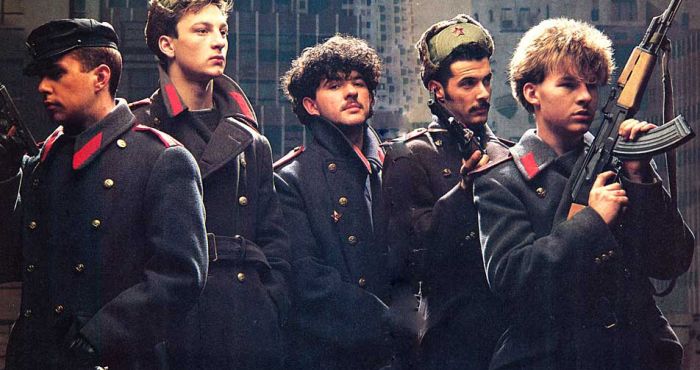
The group was Frankie Goes to Hollywood (FGTH). Their frontman Holly Johnson (vocals) was accompanied by Paul Rutherford (vocals, keyboards), Peter Gill (drums, percussion), Mark O’Toole (bass guitar), and Brian Nash (guitar). According to Johnson they got their name from a page in The New Yorker magazine, featuring the headline “Frankie Goes to Hollywood, with an accompanying picture of Frank Sinatra.

Although it was on its way down, Relax was still in the charts when FGTH released their new single in May 1984. Two Tribes had first been performed as a John Peel session in 1982. But it would be some two years before it would actually be released. The song’s title derives from the line “when two great warrior tribes go to war“, from the film Mad Max 2. The song featured the distinctive voice of Patrick Allen, the voice of the Protect and Survive public service films, which had been released a couple of years before:

“If any member of the family should die whilst in the shelter from contamination, Put them outside, but remember to tag them first for identification purposes.”

This was not satire; reflected real government advice. They also used the voice of Chris Barrie as Ronald Reagan:

“You may pronounce us guilty a thousand times over, but the goddess of the eternal court of history will smile and tear to tatters the verdict of this court – for she acquits us.”

This was an allusion to Adolf Hitler’s concluding speech when he was tried for the Beer Hall Putsch in 1924.
page6

Two Tribes went straight into the UK charts at Number One and stayed there for nine weeks. This was a considerable success in its own right, but what made it more impressive was the continuing success of Relax. With the release of Two Tribes its sales had begun to increase again, to the extent that FGTH held the top two spots in the UK charts during July 1984, a feat that had not been achieved since the 1960s. The album Welcome to the Pleasuredome was also a number-one hit. However, Frankiemania was over almost as soon as it had begun. By the time their second album, Liverpool, came out in 1986, the band’s audience had virtually disappeared.

The band’s stay was a short one but Two Tribes has been around now for 35 years and remains an iconic pop song and like nothing we will never hear again.


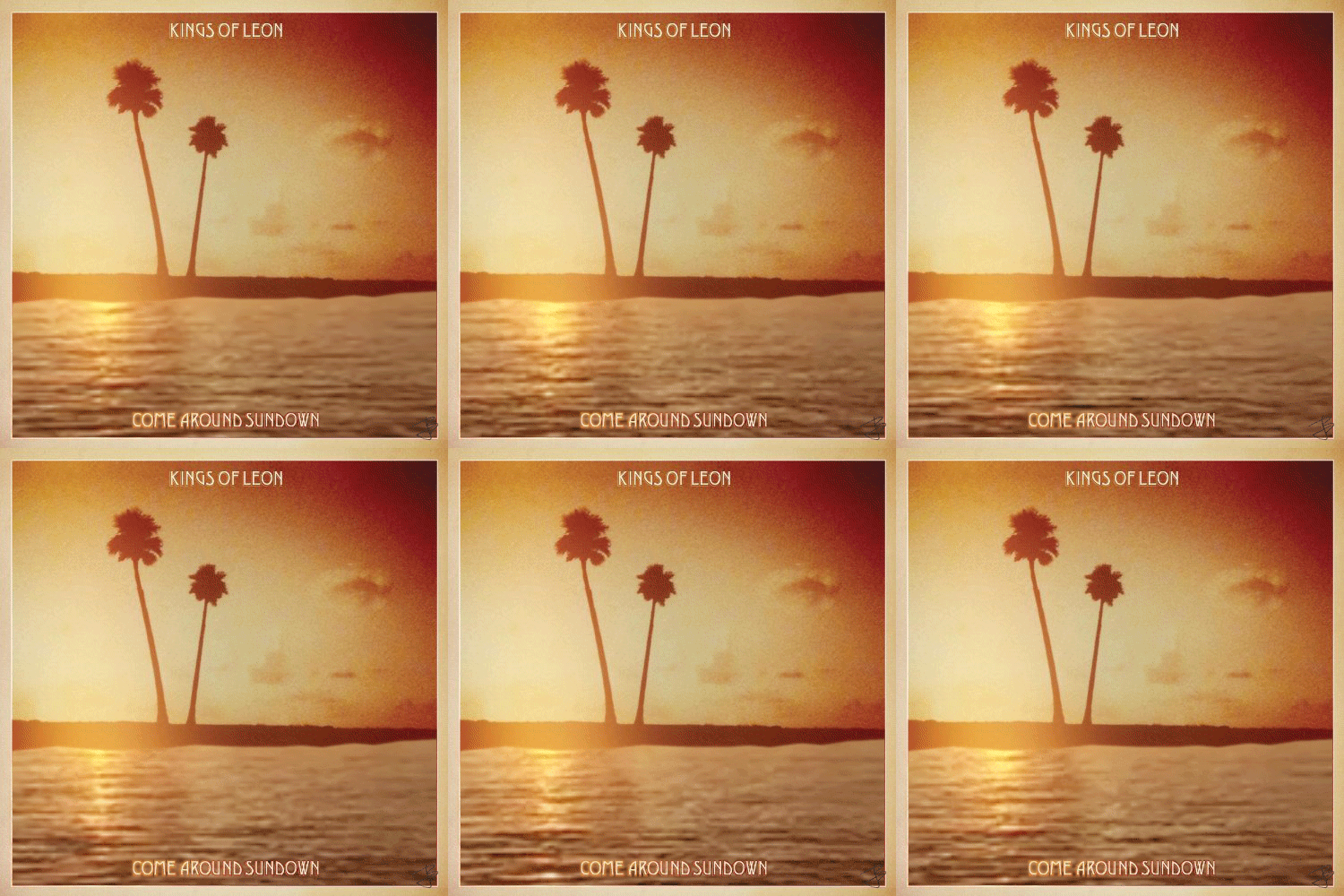
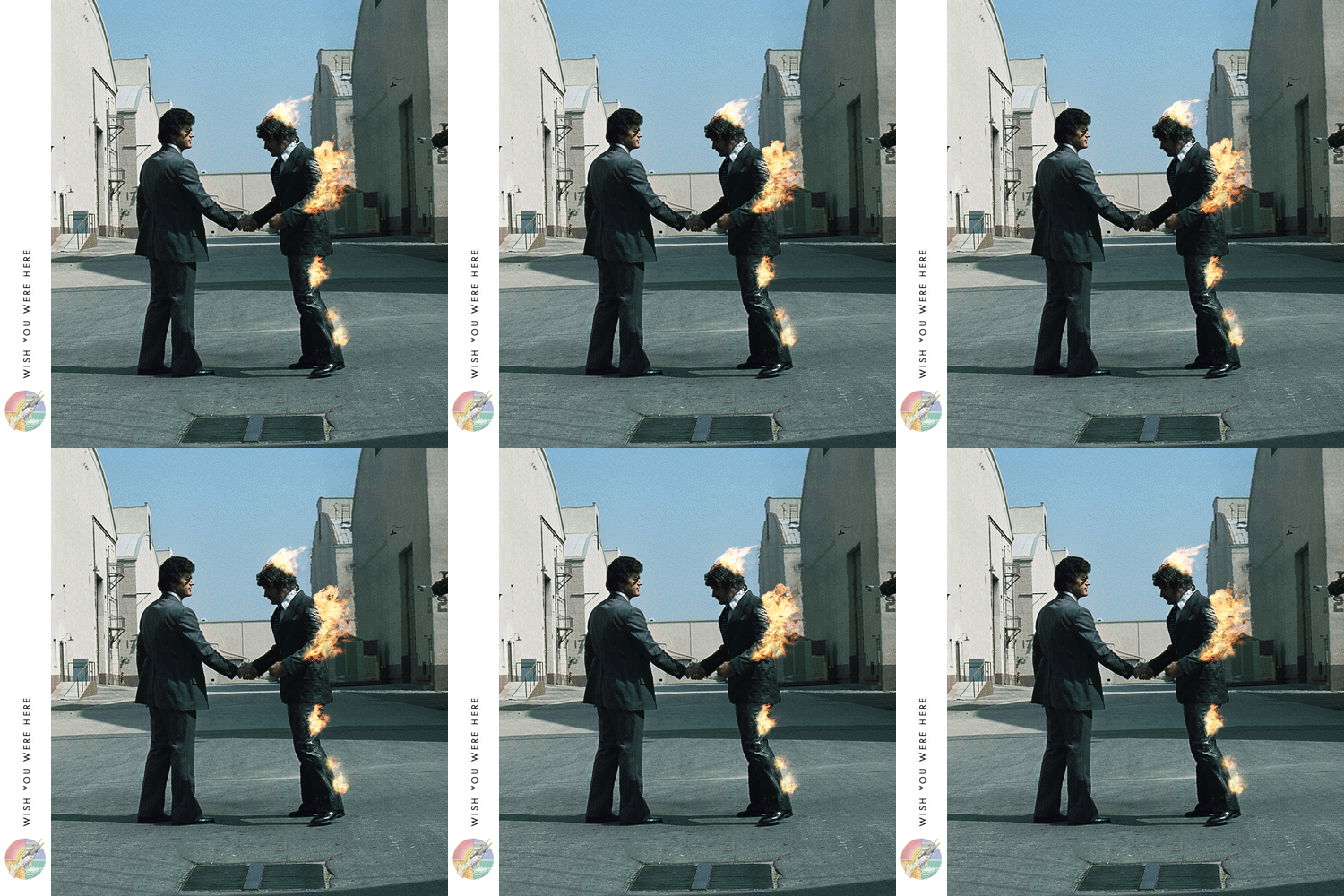
Animated Album Covers: A short-term effect?

giphy

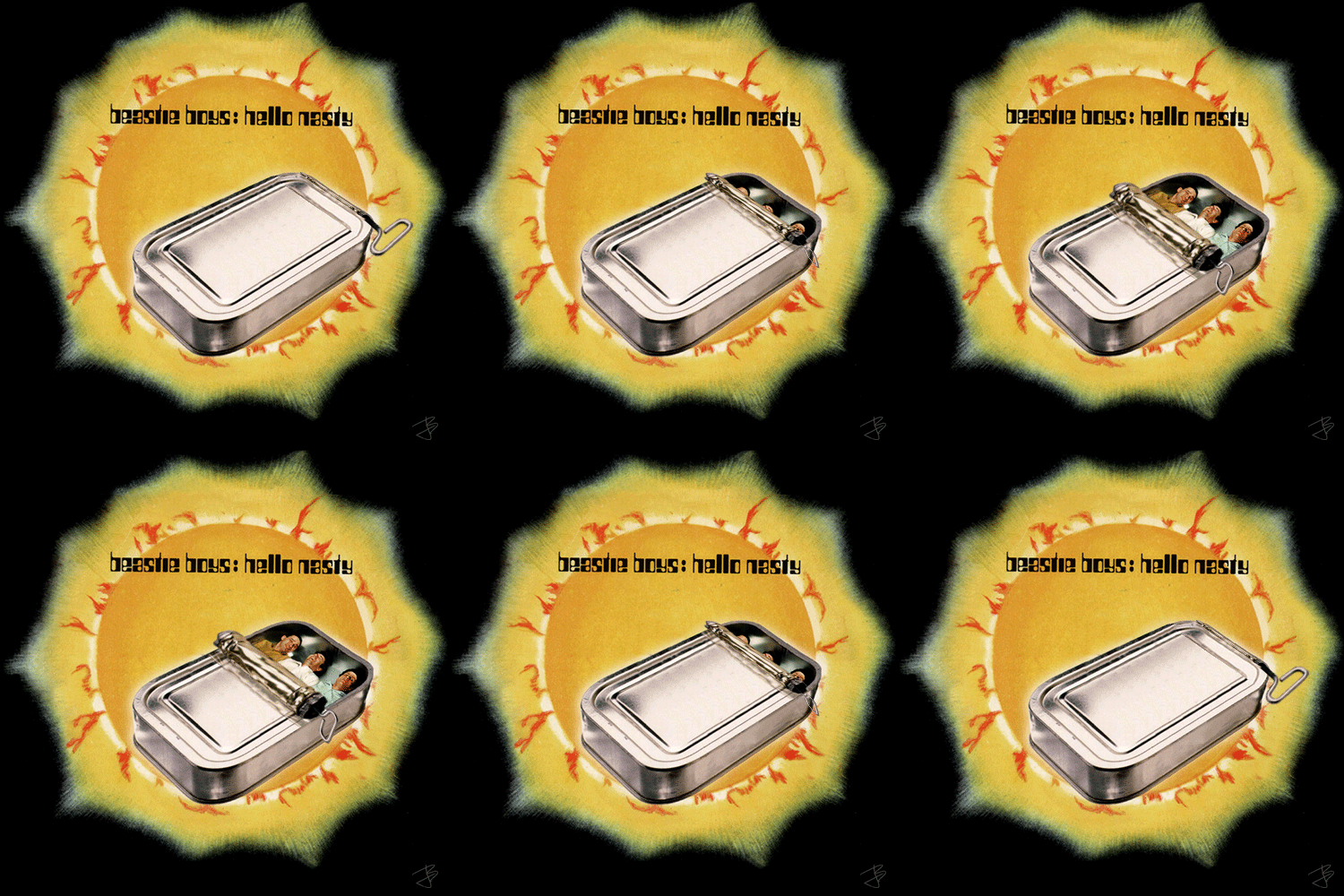
When these began appearing I wondered if it would be a fad that would ride the waves for a while and then ultimately, the novelty would wear off, You could I suppose, loosely contrast it with the de riguer of late seventies / early eighties coloured vinyl though, with vinyl very much back in vogue, repressings have seen a new devotion to colour.

tumblr_mv3dtyVoAn1sm0jo0o1_500

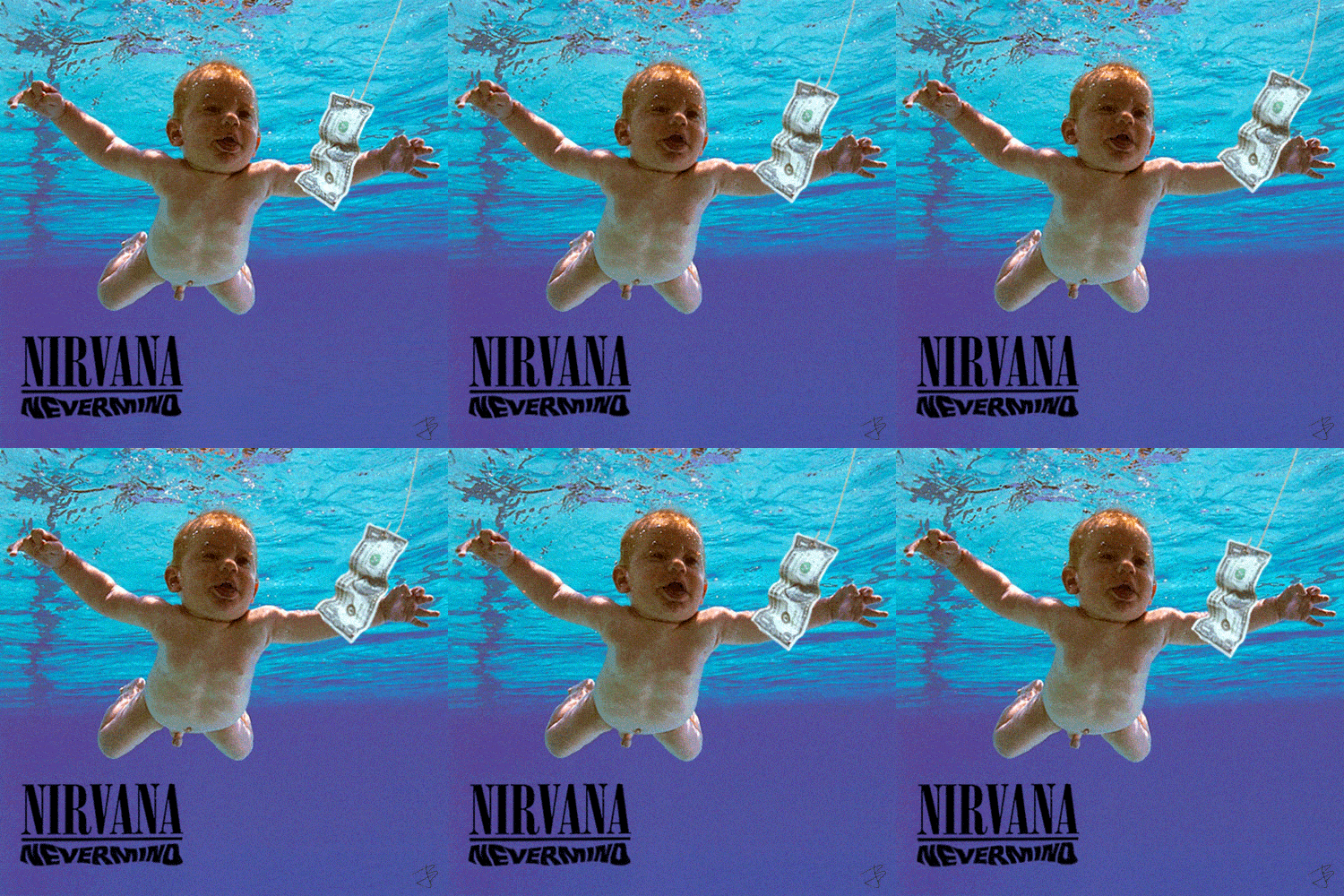
The thing I found about animated album covers was that using a variety of forums, as good as they looked, if you posted one or two to show them off, a lot of people found them just annoying, some heading to their profiles to disable moving images!

And the Nevermind one – well, the cover was controversial to begin with but I do like the animation.

tumblr_mv5ld2SrCM1sm0jo0o1_500

Like most things, some of these are very smart and clever and some really quite tacky. In this post, I aim to give a brief history into the topic and post a few of my favourites.

83447855

So on May 8th, 2010, a single topic blog on Tumblr called Animated Albums created and posted three endless GIF loops of popular albums, including David Bowie’s Low, Blondie’s Parallel Lines, and Grace Jones’ Nightclubbing. Of the three, the Blondie received the most notes, with 750. Animated Albums continued to publish animated cover GIFs through 2013.

e20

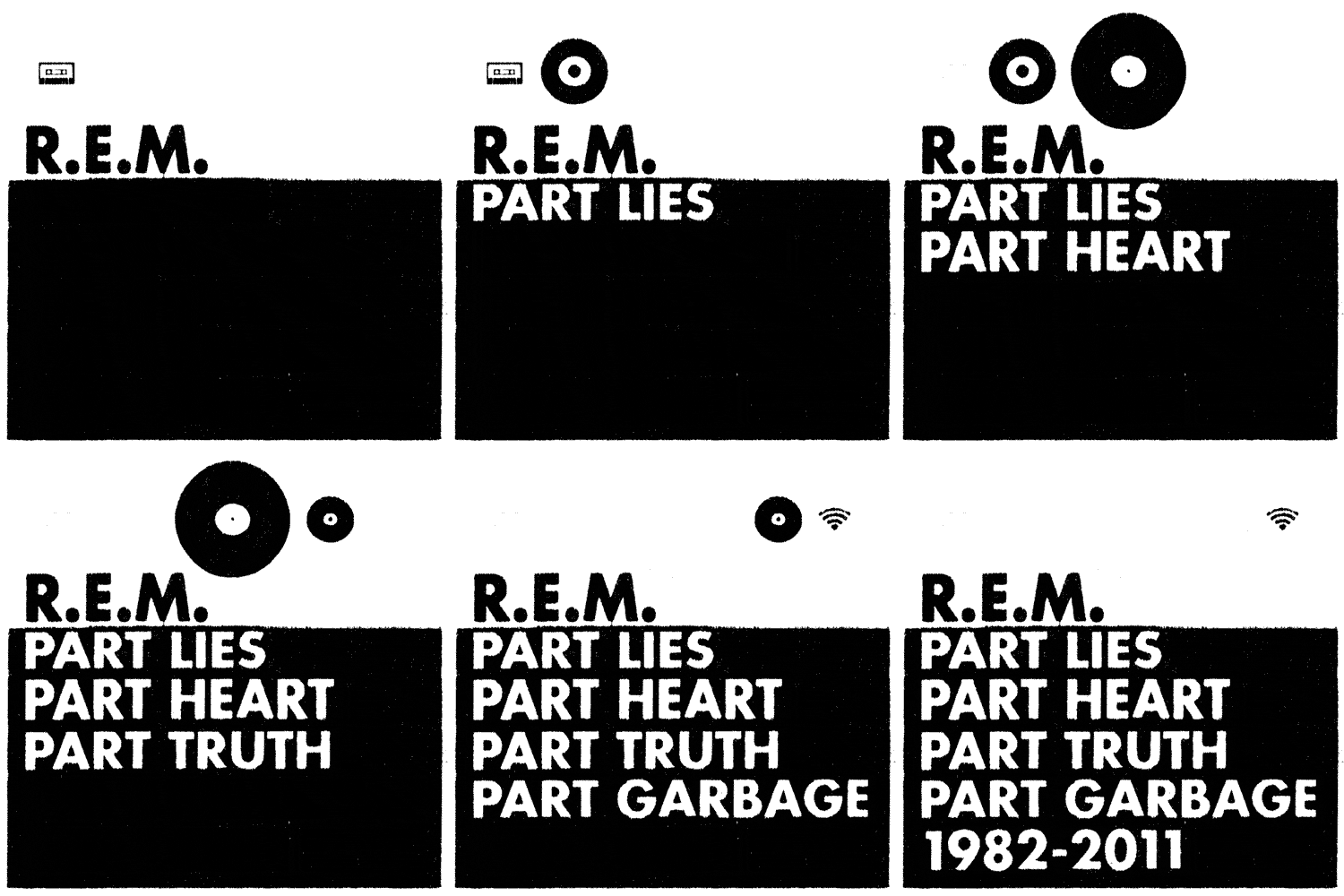
The meme went mainstream in October 2011, when the practice was adopted by the band R.E.M. as part of the promotional push for their “greatest hits” album, Part Lies, Part Heart, Part Truth, Part Garbage 1982–2011.

83447862

jbetcom’s music, another single topic blog devoted to animating album covers, began publishing in October of 2013, around the same time as Animated Albums ended. Several articles have collected instances of the meme[4][5][6], and a subreddit devoted to fans of the meme was founded in 2013 and has over 100 members.

tumblr_mwudhjsc3Q1sm0jo0o1_500

Animated album covers have proven hugely popular though whether this fad will continue to be popular will of course remain to be seen.


The Reading Festival / Revisited

4228-card

With Glastonbury still reasonably fresh in the memory, my thoughts turn to the Reading Festival which this year takes place 23, 24 and 25 August.

How many of the acts will I know?

2019 Line-up

Very few to be honest but there is an overwhelming bundle of names to explore;

The two major memories for me are from the nineties in Madder Rose and Solar Race, the latter of which the lead singer tragically took her own life (more later).

There is sadly very little footage available online from those years but this was them and this rocked…

51U7jOqKztL._SY300_QL70_

However I am thrilled to write that I can bring you “Bring It Down” from the Madder Rose set I saw in ’93…

Error
This video doesn’t exist

So before we take a look at some of this year’s Reading line-up, let’s go back in time to when and where it all began…

reading_festival_2017526_website_image_lwue_standard.jpg

While the Reading festival dates back to 1971, its origins can be traced back more than half a century.

The National Jazz Festival was first held at Richmond Athletic Ground in August 1961 but by 1965 the popularity of jazz, was giving way to that of rhythm and blues and it became the National Jazz and Blues Festival.

The following year noise complaints caused it to move to Windsor Racecourse and it led a nomadic existence, moving again to Kempton Park in 1968, Plumpton in 1969 before settling in Reading in 1971.

Reading Festival - Day 1

It had been originated by the National Jazz Federation and London’s Marquee Club which was founded by Harold Pendleton who was the festival’s promoter for many years.

It’s arrival in Reading was much different from today. It was part of the town’s Festival Of Arts at the end of June that year in which many other events were held including a procession of floats through the town centre. The site was further to the east than today, occupying the field which is now home to Rivermead, Toby Carvery and Premier Inn.

A weekend ticket to see the likes of Wishbone Ash (who were to become a festival favourite for more than a decade) Genesis, Lindisfarne, Ralph McTell and Rory Gallagher was £1.50 (for £2 got you camping as well).

reading-festival

The following year Rod Stewart and The Faces, along with Genesis once again, topped the bill. Those names along with the likes of Status Quo, Thin Lizzy, Hawkwind, Judas Priest and Dr Feelgood became synonymous with the festival during that period.

There had long been opposition to the festival from locals who had concerns over noise, drugs, thefts, violence and nude swimming and in 1978 trouble flared when punk band Sham 69 sparked a riot in which 20 fans needed hospital treatment.

After the 1983 festival the council refused to grant the organisers a licence until 1986 when that decision was reversed. However bottles and bonfires were now banned.

reading_festival_201811_website_image_jjmu_standard

The Young Ones in the form of their own band, Bad News performed in 1987 and the following year Iggy Pop were among the few highlights in a festival said to have suffered while Michael Jackson appeared at Donnington Castle the same weekend.

New organisers Mean Fiddler started to vary the music by 1989 and New Order and Billy Bragg were the kinds of headline acts during the new organiser’s early years.

In 1999 Mean Fiddler split the festival in two by running a twin event in Leeds at the same time. The two are now fully linked as one of the major dates on the music calendar.

reading_2016_sunday_MarcdeGroot0093

Festival Republic took over the running in the 2000s and off-stage innovation continued with the first BBC Introducing stage in 2008 and a new footbridge over the Thames to connect the festival with one of its campsites.

Recent years have seen headline performances from Biffy Clyro, Eminem, Green Day, The Cure, Foo Fighters and Guns N’ Roses, and in 2014 Reading Festival continues to be one of the most famous, and best, rock festivals in the world.

As mentioned earlier,…

Lead singer of ‘Madchester’ rock band may have died from overdose after ‘becoming recluse’

THE lead singer of a cult rock band may have died from a drugs overdose after living a reclusive life following the break-up of the band, an inquest has heard.

Eilidh Bradley was part of Solar Race – a grunge trio favoured by Radio One DJ John Peel and tipped at one point to be the “next Nirvana”.

The band was popular on the Manchester music scene in the eighties and nineties – known as the “Madchester” era – and at the height of their success was signed to the same record label as The Stone Roses.

But after the band split in 1998 due to “creative differences” Eilidh barely left her home and became increasingly worried her song lyrics were too “dark” and might have a “ripple effect” on fans.

She also feared she would meet a “terrible end”, the inquest heard last week.

She was found dead aged 48 in her flat – in Irlam, near Salford, Greater Manchester – in May by accident when police searching for a suspect knocked on her door.

It is believed her body had laid undiscovered for almost a month. There were empty packets of paracetamol and prescription medication for depression surrounding her.

All very sad and I loved Solar Race – they could have gone on to brighter things.

So who do we know?

Untitled

The 1975, The Wombats, Foo Fighters… Twenty One Pilots (were they at Glasto? I’m not quite sure) but what I am sure of is that Reading Festival is alive and well and getting larger by the year.

Let’s end by picking a random act from the Main Stage menu!

Blog at WordPress.com.

Up ↑